
Start Here
I love getting questions from founders on how to solve user growth every day. The Growth Engineer is my attempt to answer these at scale so they can be helpful to more people, and document how founders become the default in their category.
In a world where anyone can build anything, mastering growth and distribution is imperative.
Software adoption is changing. The buyer still matters, but agents increasingly discover products, read docs, select tools, write integrations, test workflows, and decide what gets used. That changes growth. It moves distribution closer to the product surface: APIs, docs, examples, schemas, integrations, pricing, public code, and first successful execution.
I write about that shift here.
Why I write this
I’m Lavanya. I have been coding since I was 10, became a machine learning engineer in 2017, and joined Weights & Biases as one of the first 10 employees.
I founded and led growth at Weights & Biases for seven years. My favorite way to summarize my work at W&B is this chart:
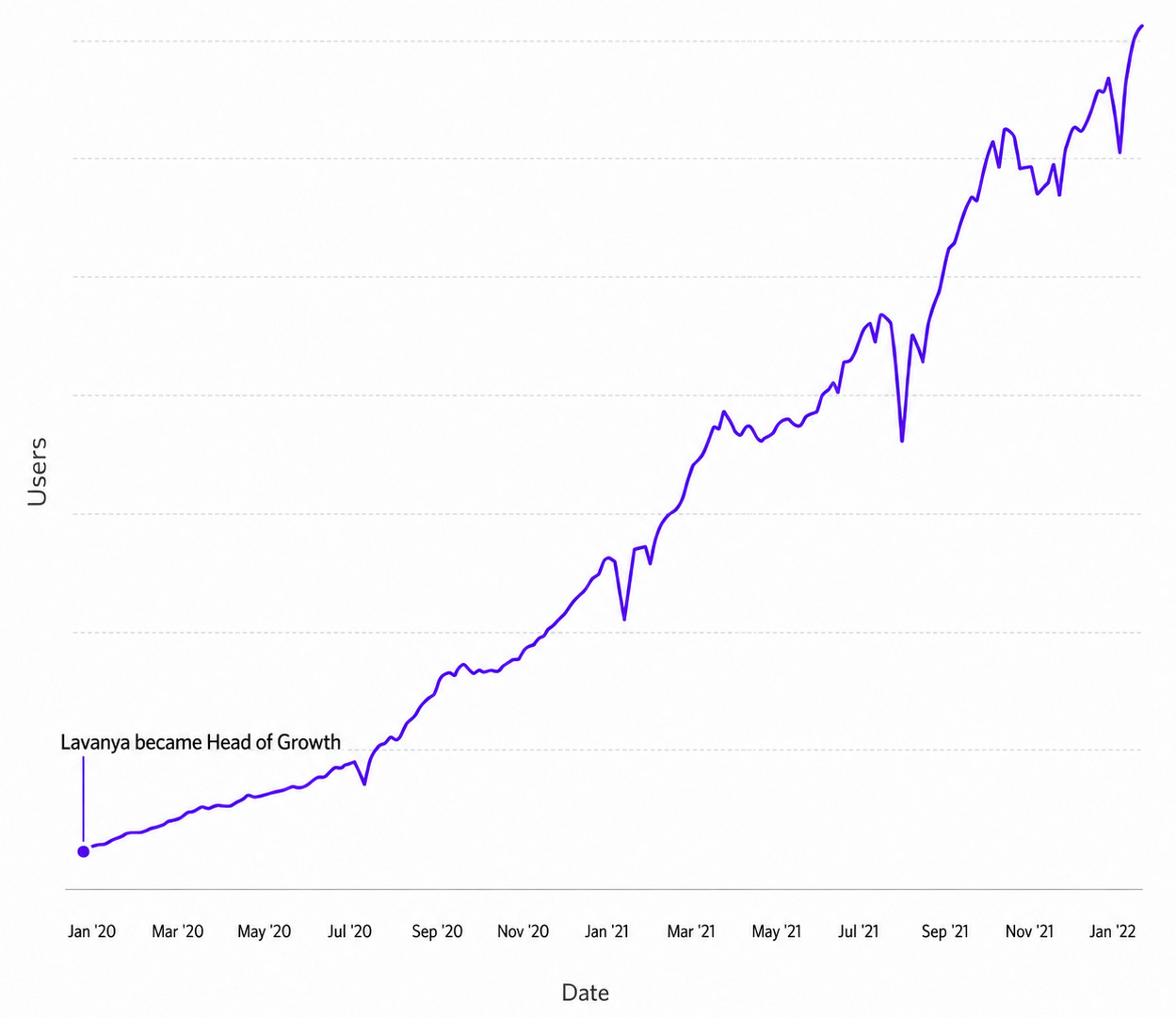
When I joined, W&B had a few 100 users. Over the next seven years, it became part of the daily workflow for millions of AI engineers, including teams at every major foundation model lab, and was acquired by CoreWeave.
The growth engine was a series of experiments, a dogged pursuit of a weekly active user metric and an the accumulation of integrations, benchmarks, high fidelity content, paper reading groups, community building, docs, open-source loops, and debugging usage patterns that made W&B the default in its category.
That is the lens behind The Growth Engineer.
In the last era, the question was how to get humans into the funnel. In this era, the question is how to become the product machines can discover, select, use, and remember.
What you will find here
The Growth Engineer is where I write about growth in the age of agents: how AI products become defaults, how agents pick tools, how documentation becomes distribution, how first execution becomes activation, how public code becomes memory, how pricing changes when workflows matter more than seats, and how founders build companies that compound through machine selection.
The goal is to provide you with practical ways to nail user growth. Together we’ll figure out:
Can an agent find your product?
Can it understand when to use it?
Can it get credentials without a human rescue step?
Can it make the first API call?
Can it recover from errors?
Can it verify the result?
Can it choose you again?
Can the code it writes with you become the public signal that teaches the next model to choose you too?
That is growth engineering.
Improbability
After W&B, I started Improbability, alongside some of the folks I wanted most in the founder’s corner, including Lukas Biewald and Chris Van Pelt (cofounders of W&B) and supported by LPs like Sequoia, Peter Welinder (OpenAI), Stuart Bowers (DeepMind), Joe Spisak (Meta/Reflection), Adrien Treuille (Streamlit founder), Adrien Gaidon (TRI, Walden Robotics), Jonathan Siddharth (Turing CEO), Dwight Crow (additive), BloombergBeta and Thomas Laffont (Cofounder, Coatue). We have assembled the sharpest people in AI, to ensure our founders have the best support system no matter what problem they face.
We invest in ambitious AI infrastructure and application companies at pre-seed, seed, and occasionally Series A.
We write $500k-$1M checks. We make decisions quickly, usually within a week. We do not take board seats. We try to be the kind of investor founders call first when they face the hairy problems running companies.
How I work with founders
I want to back deeply technical AI founders, who move fast, have a history of building in public and care deeply about becoming the default in their category.
I learned that at W&B. One reason we won was that Lukas (our CEO) cared deeply about user growth, he called it the oxygen for the company. We looked at the growth metrics every week. We cared about them like our lives depended on them, because in the early years they did. The dogged pursuit of growth metrics allowed us to make hard decisions until the product become part of the daily workflow for AI engineers.
That is the kind of founder I want to work with now: someone who treats distribution as part of the product from the beginning, someone who won’t settle for anything but being the default in their category.
I am most useful when the product is technical, the market is early, and the founder is trying to figure out not only what to build, but how the product becomes the default.
Get in touch
If you are a founder working on an ambitious AI startup, reach out. I’d love to be your first institutional check and help you become the default in your category.
We invest $500k-$1M in pre-seed and seed rounds, with occasional Series A checks. We make decisions quickly, do not take board seats, and try to be the kind of investor founders call when solving the hairiest company building questions.
Send me a short note with what you’re building, a demo link, and why this can become the default in its category. I don’t need a deck. I’d rather see the product in motion, even if it is early, rough, or half-built.
