

Part of the Growth Engineering series. Start with Growth Engineering in the Age of Agents for the full thesis.
Every growth era has one metric that tells the truth before the board deck does.
At Weights & Biases, ours was Weekly Returning Users. We looked at it every week because it told us whether W&B was becoming part of the daily work of AI engineers. The maniacal focus on that number forced hard product decisions, hard growth decisions, and hard prioritization decisions. It was not a vanity metric. It was the closest proxy we had for becoming the default in our category.
In the agent era, that metric changes.
If your product is being used by agents, you do not only have users in the traditional sense. You have workflows. An agent may create value without logging in. It may run fifty times in ten minutes and then disappear for three days. It may generate thousands of API calls that mean nothing because the workflow is broken.
That is why DAU, MAU, and raw API calls start to miss the point.
The new north star is Weekly Active Workflows.
A Weekly Active Workflow is a valuable workflow completed successfully in the last week, whether initiated by a human, an agent, or both.
A workflow is not a single API call. It is a goal-directed sequence that starts with intent and ends with a verifiable outcome: send the email, deploy the app, run the evaluation, reconcile the invoice, create the report, update the CRM, provision the sandbox, complete the transaction.
The unit that matters is not whether someone logged in.
The unit that matters is whether the work got done.
Why workflows beat users
DAU and MAU worked when a login was a reasonable proxy for value. In agent-led software, login is often downstream of value, or absent entirely.
An agent can call your API, configure your SDK, complete a workflow, and never create the kind of session your growth dashboard was built to measure. The opposite can also happen: a broken agent can hammer your API all day and create usage without value.
Weekly Active Workflows filters for the thing founders should actually care about:
Was there a real goal?
Did your product participate in completing it?
Did it succeed?
Did it happen recently enough to mean the workflow is still alive?
That last point matters. “Weekly” filters out stale configs. “Active” filters out broken workflows generating noise. “Workflow” forces the team to measure completed value rather than activity.
If DAU asks, “How many people showed up?” WAW asks, “How many jobs did we help finish?”
The dashboard evolves
Once workflows become the north star, the supporting metrics change too.
Activation becomes First Successful Execution.
Can an agent complete the intended job with your product in the loop for the first time?
Time-to-value becomes token-to-value.
How much context, setup, documentation, retrying, error handling, and human rescue does it take before an agent gets the first correct result?
Retention becomes Agent Retention.
When the same job appears again, does the same agent, user, project, or organization choose you again?
Revenue becomes workflow revenue.
Are you pricing around the unit of value the product actually completes, or around seats that agents do not have?
Referral becomes propagation.
Does a successful workflow create public code, templates, docs, configs, examples, or defaults that make the next agent more likely to choose you?
The old growth dashboard was built around a human funnel. The agent-era dashboard is built around completed work.
The W&B learning
At W&B, Weekly Returning Users gave us a single scoreboard. When the number dipped, we could ask the right questions quickly: which cohort, which channel, which workflow, which product surface, which part of the funnel?
The point of a north star is not to reduce the company to one number. The point is to make every creative decision accountable to the same truth.
Lukas called user growth oxygen for the company. We cared about the metric because, in the early years, it told us whether the product was becoming a habit. If W&B was not part of the weekly rhythm of AI engineers, nothing else mattered.
Weekly Active Workflows plays the same role in the agent era.
It tells you whether your product is becoming part of how work gets done.
Token-to-value
Time-to-value was one of the central metrics of product-led growth. How fast could a human reach the aha moment? Dropbox optimized for the first file. Slack optimized for the first message. W&B optimized for the first useful experiment logged.
Token-to-value is the agent-era version.
Token-to-value asks: how much does an agent have to spend before your product produces a verified result?
Not just tokens in the literal model-billing sense, though that matters. Token-to-value also includes docs pages, setup steps, tool calls, credentials, retries, context hops, error recovery, and human interventions.
Lower token-to-value becomes a distribution advantage.
If two products solve the same problem, the agent will tend to favor the one it can understand, authenticate, call, debug, and verify with fewer steps and fewer failure points.
That is why Resend beats SendGrid in agent selection even though SendGrid is valuable enterprise infrastructure. SendGrid has deep deliverability history, dedicated IPs, enterprise motion, and years of trust. But for an agent trying to add email in one pass, Resend has lower token-to-value: a simpler API, clearer examples, fewer concepts to hold in context, and a faster path to first successful execution.
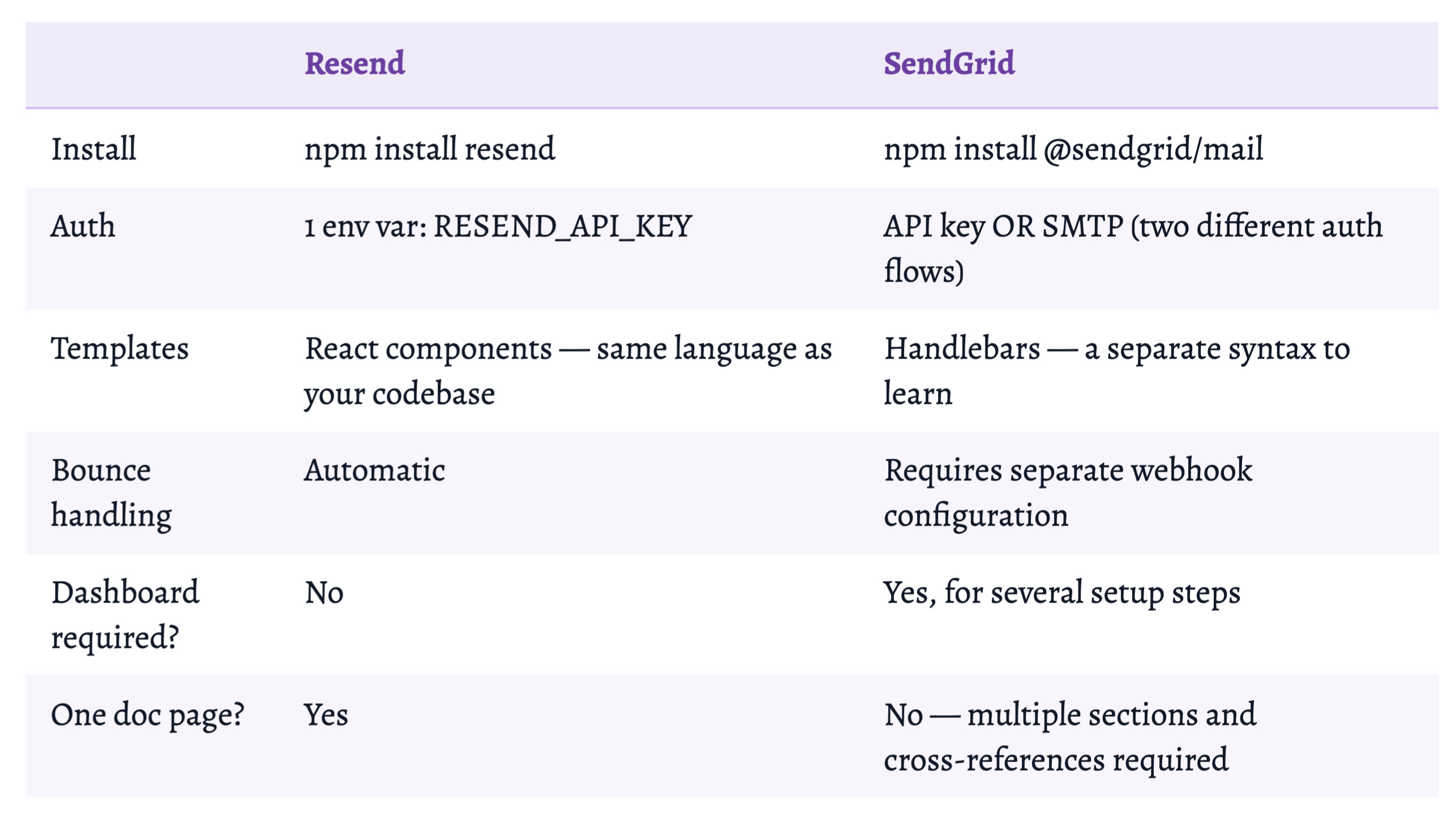
Agents choose like builders, not buyers.
They do not reward completeness in the abstract. They reward the path that works.
What lowers token-to-value
The practical work is not mysterious. It is just more technical than most growth teams are used to.
A product lowers token-to-value when:
The docs say exactly when to use it and when not to use it.
The API surface is small enough for an agent to reason about.
The first useful path does not require a credit card, a human-only login flow, or an email confirmation loop.
The examples are current, complete, and copyable.
The error messages tell the agent what to do next.
The schema is stable and predictable.
The result is easy to verify.
“Unauthorized” is not an error message an agent can work with. “API key missing. Set RESENDAPI_KEY in your environment. It should start with re” is a recovery path.
That difference leads to predictable growth.
It is also selection debt. Every ambiguous doc, bloated schema, brittle auth flow, unclear tool name, missing example, and bad error message makes an agent less likely to choose you next time.
Do not expose complexity and call it agent-ready
The naive version of building for agents is to expose every endpoint, every tool, and every feature.
That is usually wrong.
Agents do not reward maximal surface area. They reward the shortest reliable path from intent to result. A product with three excellent operations can beat a product with forty exposed endpoints if the smaller surface is easier to choose and execute.
This is the lesson behind Cloudflare’s Code Mode pattern. The right answer to thousands of possible operations is not always thousands of individual tools. Sometimes the better agent interface is a small number of high-leverage tools that let the agent search, reason, and execute against a typed representation.
That is the mental shift: agent-readiness is not a docs project. It is an architecture problem.
WAW and pricing should align
The most important reason to measure Weekly Active Workflows is that it can align growth and revenue.
If your north star is completed workflows and your pricing is also tied to completed workflows, every growth experiment can move revenue, and every pricing decision can improve or damage the growth motion.
That is much cleaner than optimizing one system for seats and another system for usage.
Agents do not have seats. They complete jobs. They do not feel upgrade friction, read a “contact sales” page, or ask procurement to approve a feature gate. If the pricing path blocks the workflow, the agent may simply route around you.
The best agent-era pricing will probably be hybrid. Humans still need budget predictability, governance, approvals, and trust. Agents need the ability to start, repeat, and scale workflows without breaking the path.
The principle is simple:
Do not make your pricing unit fight your value unit.
If the product creates value by completing workflows, price in a way that lets workflows start easily, repeat naturally, and expand when they become important.
What to track next to WAW
WAW is the north star, but it should not be the only metric.
Track Execution Success Rate: what percentage of attempted workflows complete successfully?
Track First Successful Execution: how often does a new agent or project reach the first verified outcome?
Track token-to-value: how much context, setup, retrying, and human rescue does the first successful workflow require?
Track Agent Retention: when the same job appears again, does the agent choose you again?
Track Workflow Revenue: how much revenue is tied to completed workflows rather than seats, sessions, or raw calls?
The warning sign is when these metrics diverge.
If WAW is growing but Execution Success Rate is falling, growth is hiding reliability debt.
If WAW is flat but token-to-value is improving, you may be preparing for a future selection gain the revenue dashboard has not seen yet.
If Agent Retention falls while revenue is steady, you may be getting ghosted by the machines before customers formally churn.
A product can lose distribution before it loses revenue.
It’s 2026. Build. For. Agents.
The current moment feels like early PLG.
Dropbox, Slack, and other PLG winners built distribution advantages before the rest of the market understood what they were optimizing for. Years later, the wins looked obvious. They did not look obvious at the time.
The same thing is happening now.
Most teams still optimize human onboarding while agents are learning which products to pick, which docs to trust, which APIs to call, and which workflows to repeat. The defaults of the next software market are being shaped by today’s successful executions.
Every successful agent workflow is a vote for the next selection.
Every public repo is a signal.
Every starter template is a distribution asset.
Every useful error message is a recovery path.
Every low-token integration is a reason to choose you again.
The old question was, “How many users came back this week?”
The new question is, “How many valuable workflows did we complete this week, and how many of them made us more likely to be chosen again?”
That is the dashboard for growth engineering.
“It’s 2026. Build. For. Agents.” – Andrej Karpathy
If you are a founder working on an ambitious AI startup, reach out.
I’d love to be your first institutional check and help you become the default in your category. We invest $500k-$1M in pre-seed and seed rounds, with occasional Series A checks.
Send me a short note with what you’re building, a demo link, and why this can become the default in its category. I do not need a deck. I would rather see the product in motion, even if it is early, rough, or half-built.
Thank you to Lukas Biewald, James Cham, Amy Tam and Phil Gurbacki for early feedback on this draft.
Lavanya Shukla is Managing Partner of Improbability.vc, an early-stage AI fund, and former Head of Growth at Weights & Biases, where she led growth from about 100 users to millions of AI engineers. She writes The Growth Engineer, a field guide for founders who want to become the default in their category in the age of agents.
